




Left Logo Left Logo 2 Left Logo 3

Right Logo Right Logo 2


Enhancing Discharge Care Planning: A Probabilistic Data-Driven Approach


Mustafa Aslan, Cardiff University, UK
Lead supervisor: Prof. Bahman Rostami-Tabar
Co-supervisor: Dr. Jeremy Dixon
Data Lab for Social Good
Cardiff University, UK

9 Oct 2025

Outline

  • What problem(s) does our research focus on?

  • Research Questions and How We Address Them

  • Methodology & Approach

  • Progress so far?

Outline

  • What problem(s) does our research focus on?

  • Research Questions and How We Address Them

  • Methodology & Approach

  • Progress so far?

What problem(s) does our research focus on?

Problem

  • The challenge of capacity management
    • Inefficient use of healthcare and social care resources
  • Inadequate discharge care coordination
    • Difficulties with discharging medically fit patients in a timely manner

Why it matters

Poorly managed discharge processes negatively affect both individuals and patient flow through hospitals, creating bottlenecks that increase pressure on all healthcare services.

Who it impacts

Patients, healthcare professionals, and the overall healthcare system.

Outline

  • What problem(s) does our research focus on?

  • Research Questions and How We Address Them

  • Methodology & Approach

  • Progress so far?

❓Research Questions and How We Address Them

❓Research Questions and How We Address Them

❓Research Questions and How We Address Them

❓Research Questions and How We Address Them

Outline

  • What problem(s) does our research focus on?

  • Research Questions and How We Address Them

  • Methodology & Approach

  • Progress so far?

🛠️ Methodology & Approach

Data

  • SAIL Databank
  • Patient-level data sources

Model Development

  • Mathematical modelling
  • Stocastic optimization and reinforcement learning methods
  • Machine learning
  • Probabilistic modelling

Validation and Testing

  • Cross-Validation to test predictive models
  • Test models in a real-world setting, possibly in collaboration with a hospital

Outline

  • What problem(s) does our research focus on?

  • Research Questions and How We Address Them

  • Methodology & Approach

  • Progress so far?

Progress so far?

Models

Regime-Switching AutoRegressive Hidden Markov Model (RS-ARHMM)

Let \(y_t\) be the observed value at time \(t\), modeled as a function of its \(p\) lagged values, the regime-specific parameters associated with the hidden state \(s_t\), and exogenous variables \(\mathbf{X}_t = (X_{t1}, \ldots, X_{tM})\).

The RS-ARHMM can be expressed as follows:

\[ y_t^{(s)} = \beta_{0}^{(s)} + \sum_{i=1}^{p} \beta_{i}^{(s)} \, y_{t-i} + \sum_{j=1}^{M} \beta_{p+j}^{(s)} \, X_{tj} + \epsilon_t^{(s)}, \]

Parameter estimation: EM (Expectation-Maximization) Algorithm

  • Iteratively estimates parameters \(\Theta = \{\beta^{(s)}, \sigma^{2(s)}, P, \pi\}\) to maximize likelihood.

    • Transition probabilities stored as: \[ P = \begin{pmatrix} p_{11} & \cdots & p_{1K} \\ \vdots & \ddots & \vdots \\ p_{K1} & \cdots & p_{KK} \end{pmatrix} \]
  • Alternates between two steps:

    • E-Step: Estimate regime probabilities given current \(\Theta\).
    • M-Step: Update \(\Theta\) using these probabilities.

Benchmark models

Statistical models:

  • Exponential Smoothing (ETS): A state space time series model capturing level, trend, and seasonality.
  • Linear Regression: A statistical model that estimates the linear relationship between predictors and a response variable.
  • Lasso Regression: A regression method with L1 regularization, useful for variable selection and preventing overfitting.

Machine Learning models:

  • XGBoost: An optimized gradient boosting library designed to be highly efficient and flexible.
  • LightGBM: A gradient boosting framework that uses tree-based learning algorithms, known for its speed and efficiency. It uses leaf-wise tree growth.
  • Random Forest: An ensemble learning method that builds multiple decision trees and merges them together to get predictions.

Probabilistic Forecasting - Conformal Prediction

  • A distribution-free method for constructing prediction intervals

  • A way to quantify the uncertainty of point forecasts by generating prediction intervals

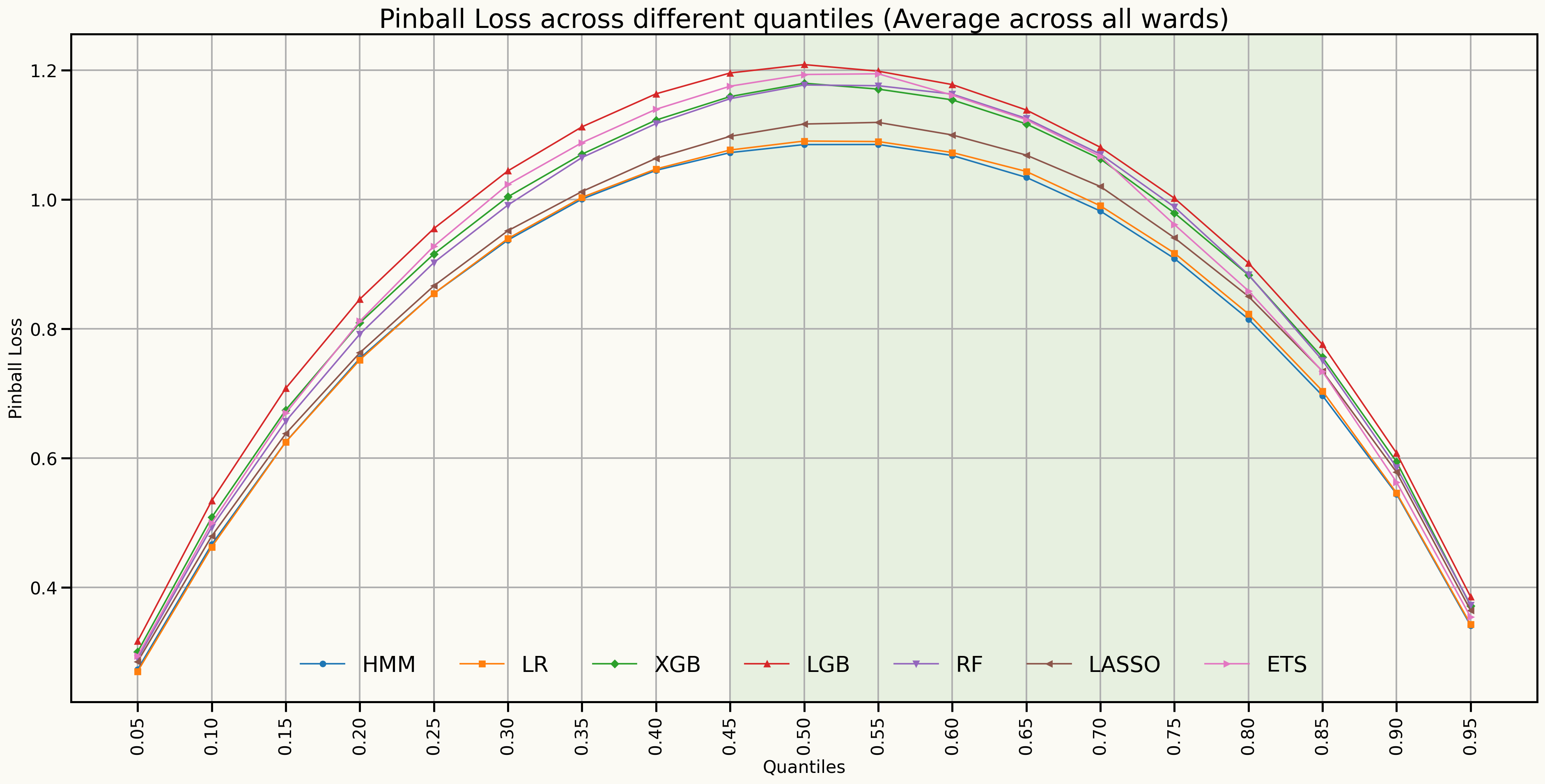
Forecast Distributions (Quantile scores)

Any questions or thoughts? 💬